
Blooming Through the Brain Fog: Brain Health, Mood, and Perimenopause

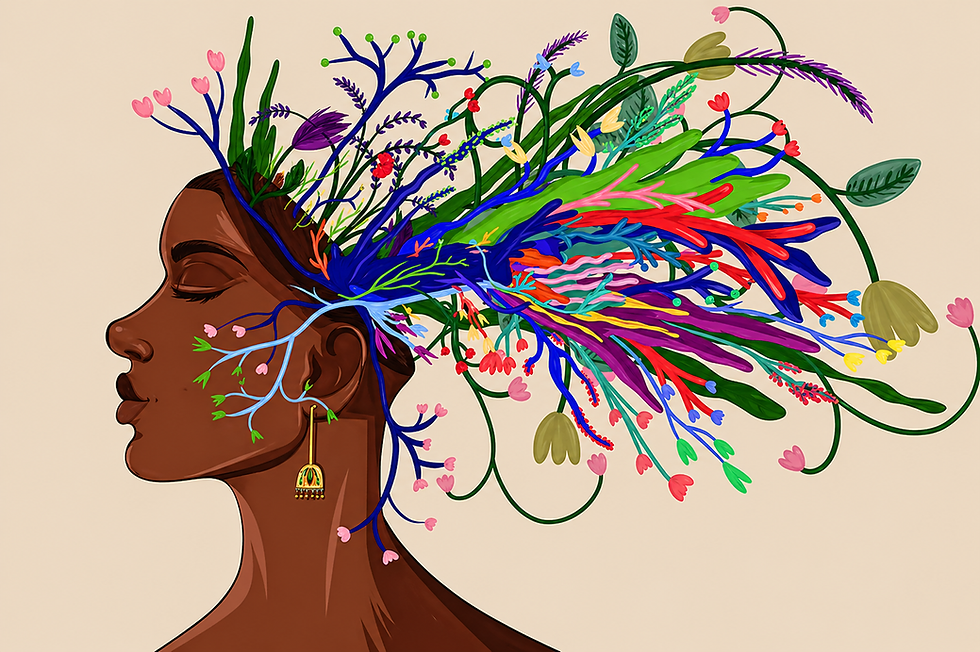
There is something deeply unsettling about feeling unlike yourself.
You walk into a room and forget why. You lose a word mid-sentence. Your patience feels thinner. Your sleep is lighter. Your emotions arrive louder than expected.
For many women in perimenopause, these experiences can feel confusing—and sometimes frightening. Many begin to ask themselves:
“Am I losing my memory?"
”Why do I feel so anxious?"
”Why does everything suddenly feel harder?”
The truth is: your brain is changing.
And no, this does not mean something is wrong with you.
It means your body is moving through one of the most profound transitions of your adult life.
Perimenopause Is a Brain Transition, Too
We often think of perimenopause as a hormonal or reproductive shift, but it is also a neurological transition.
Estrogen does much more than regulate periods—it supports brain function, mood stability, sleep quality, memory, and even how we process stress.
As estrogen begins to fluctuate, many women notice:
Brain fog
Difficulty concentrating
Increased anxiety
Mood swings
Irritability
Sleep disruption
Fatigue
Loss of motivation
Feeling emotionally “off.”
These symptoms are not imagined. They are real, biological, and incredibly common.
For Black women especially, these changes are often intensified by the long-term effects of chronic stress, caregiving burdens, and what Dr. Arline Geronimus calls weathering—the cumulative impact of stress on the body over time.
When life has required you to be strong for everyone else, perimenopause can feel like your nervous system asking for a new kind of care.
Mood Changes Are Often the First Signal
Many women come into therapy believing they are suddenly “too emotional.”
But often, what they are experiencing is not weakness—it is depletion.
Poor sleep affects emotional regulation. Hormonal shifts affect serotonin and dopamine. Stress affects cortisol. Years of over-functioning create exhaustion.
The result?
You may feel more anxious, more tearful, more reactive, or less interested in things that once brought joy.
This is not failure.
This is information.
Your body is asking you to listen.
Supporting Brain Health During Perimenopause
The goal is not simply to “push through.”
The goal is to support your brain and body so you can move through this season with clarity and compassion.
A few foundational supports include:
Sleep Protection
Sleep becomes medicine in midlife.
Prioritize sleep hygiene:
consistent bedtime
reduced evening stimulation
less alcohol and sugar late in the day
magnesium, if appropriate
conversations with your provider if symptoms are severe
Strength Training and Movement
Exercise is one of the strongest protectors of brain health.
Resistance training supports:
mood
cognition
metabolism
sleep
bone health
confidence
It does not have to be complicated.
Sometimes healing begins with a weight bench in the spare bedroom and a promise to yourself.
Nourishment
Protein, healthy fats, hydration, fiber, and reducing blood sugar spikes all matter.
Your brain needs fuel.
Skipping meals and surviving on caffeine may have worked before—but your body is asking for something different now.
Stress Reduction
Not spa-day stress reduction.Real nervous system support.
Breathing.Walking.Boundaries.Quiet.Therapy.Saying no.Rest without guilt.
Defying Gravity Means Caring for the Woman Becoming
Perimenopause is not simply about symptom management.
It is an invitation.
An invitation to stop abandoning yourself.
An invitation to ask:
What do I need now?
What no longer fits?
What would flourishing actually look like?
In my work with women in midlife, I often say this:
We are not trying to go back. We are learning how to rise and move forward.
That is Defying Gravity.
Not pretending everything is fine.
But learning how to care for yourself with wisdom, courage, and intention.
Final Thought
If your mind feels scattered, your emotions feel louder, and your body feels unfamiliar—you are not broken.
You are in transition.
And transition, while uncomfortable, is often where transformation begins.
Take a breath.
Begin again.
Because this next season of your life deserves not just survival—
but flourishing.


Comments